
01 / Service and availability
What garage door maintenance covers
Routine assessment of a residential garage door, opener, and visible safety features. Confirm which maintenance tasks Proven currently offers at your address and what is included in the visit.
Proven’s regional plan starts from Warwick, New York. Review the service-area directory and confirm coverage, timing, and any travel charge for your address. The booking channel is still being finalized; the repair-summary tool prepares details in your browser and does not send a request.
02 / Symptoms
Signs that call for a closer look
- A new squeak, scrape, or rattle develops during travel.
- The door moves less smoothly than before or seems slightly uneven.
- The opener reverses intermittently or the safety-sensor lights change.
What a homeowner can observe safely
From the floor and without touching loaded hardware, note new grinding or scraping sounds, uneven travel, visible damage, and whether the door closes normally. Clear ordinary obstructions from the opening, but stop using a door that looks unstable.
03 / Types and options
Understand the repair choices
Observation versus adjustment
A quieting spray is not a diagnosis. Worn rollers, loose hinges, track resistance, or opener behavior may need different attention.
Maintenance versus repair
Ordinary inspection and upkeep differ from replacing a frayed cable, broken spring, or damaged section. Loaded lifting hardware should be left to a trained technician.
Manufacturer guidance
Lubrication, sensor care, and operating checks vary by door and opener model. Use the manufacturer’s instructions rather than a universal maintenance recipe.
What a professional assessment may cover
Ask which hinges, rollers, tracks, cables, springs, weather seals, opener controls, and safety sensors will be evaluated. The inspection should distinguish normal wear from a specific repair recommendation, with findings explained before work begins.
Is it routine upkeep or a repair?
A new noise or rough movement does not identify a part by itself. An assessment should look at the door’s movement, lifting hardware, opener behavior, and safety features before recommending work. A visibly broken spring, loose cable, or crooked door calls for repair attention rather than another operating test.
04 / What a visit may include
From inspection to final checks
- Discuss when the noise or movement changed and check the door’s visible condition.
- Review hinges, rollers, tracks, cables, springs, seals, opener controls, and safety sensors as appropriate to the equipment.
- Explain any proposed adjustment or repair separately, then check travel and safety functions after authorized work.
Maintenance is not a substitute for repair
A frayed cable, broken spring, displaced roller, or door that hangs crookedly needs diagnosis. Do not loosen bottom brackets or spring hardware, pull a cable, bypass a sensor, or repeatedly cycle an unsafe door.
Actual steps depend on the door, the diagnosis, and the work you authorize.
05 / Price information
What shapes the estimate?
Ask which components will be inspected, what adjustments or materials are included, and whether any proposed replacement part is quoted separately. If a problem is found, ask for the cause, the available options, and the scope in writing before authorizing additional work.
- The inspection scope and number of doors or openers.
- Any adjustments or parts needed beyond the basic visit.
- Access, labor, travel or diagnostic charges, and follow-up work if a repair is found.
No verified fixed price or price range has been supplied for publication. Ask for the diagnostic and travel charges, the complete proposed scope, and written terms before authorizing work.
06 / Trust and proof
Proof and warranty details to check
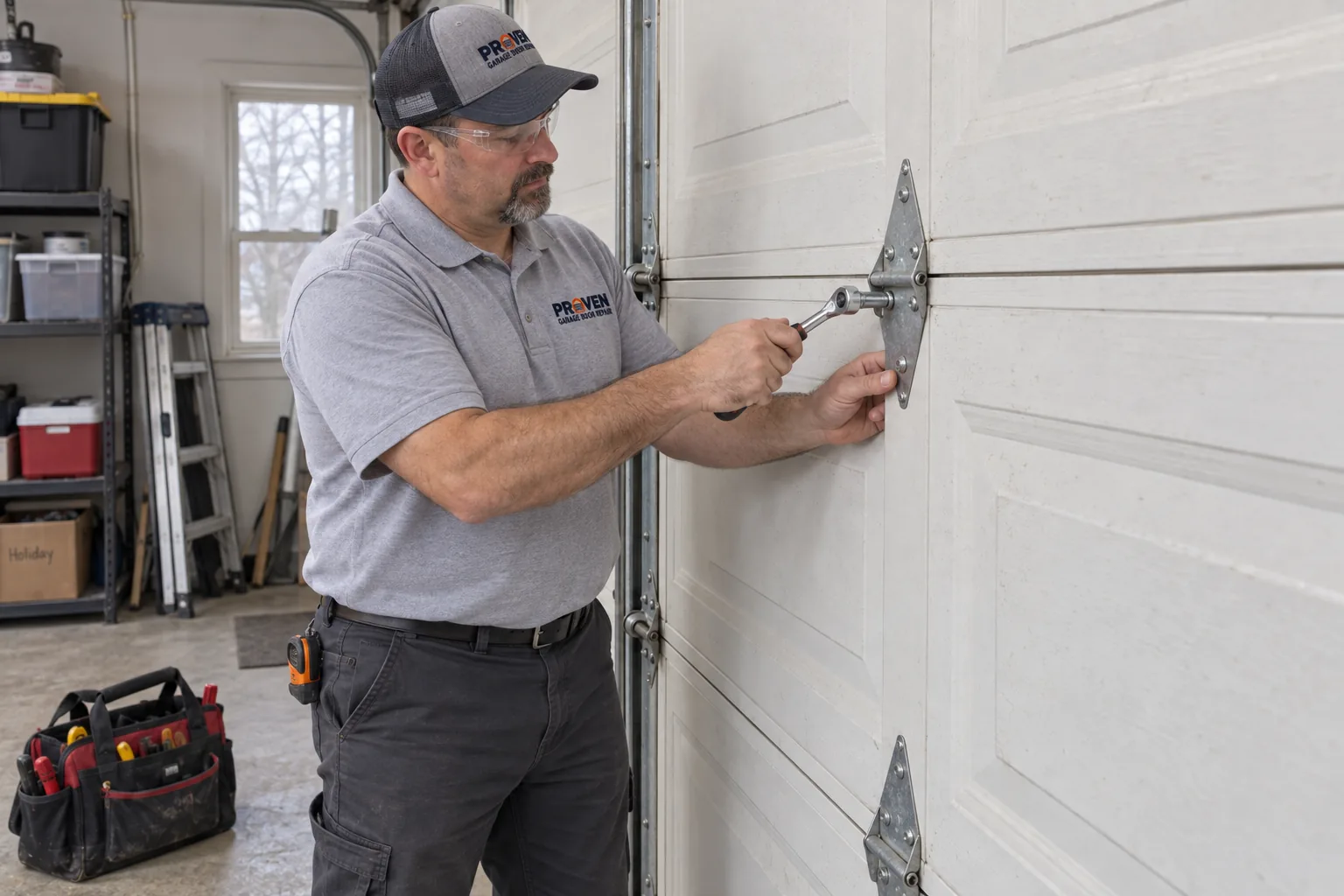
Ask for a written list of what was inspected, what was adjusted, and what needs repair later. Request real service photos, technician background, customer feedback, and warranty terms where applicable. None of those Proven-specific proofs has been supplied for this page yet; its technician image is illustrative.
See how Proven approaches repair decisions. Website service images are illustrative and are not evidence of a completed job.
Before an appointment
- Write down when the noise or movement changed.
- Note the opener model if visible without climbing.
- Keep the floor and door path clear for an assessment.
Questions homeowners ask
Should I lubricate a noisy garage door?
The right treatment depends on the part and the manufacturer’s instructions. Noise can also come from worn rollers, loose hardware, or a door that binds. Do not spray an unknown lubricant onto every surface or adjust springs and cables yourself.
How can I tell whether the safety sensors need attention?
If a closing door reverses, check for an obvious obstruction from a safe position and note the sensor indicator lights. Do not bypass or reposition safety devices to make a faulty door close. An opener and door assessment can separate sensor trouble from mechanical resistance.
Related repair guides
garage door opener repair and garage door spring repair may help if the symptoms involve more than one part of the door.